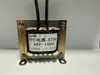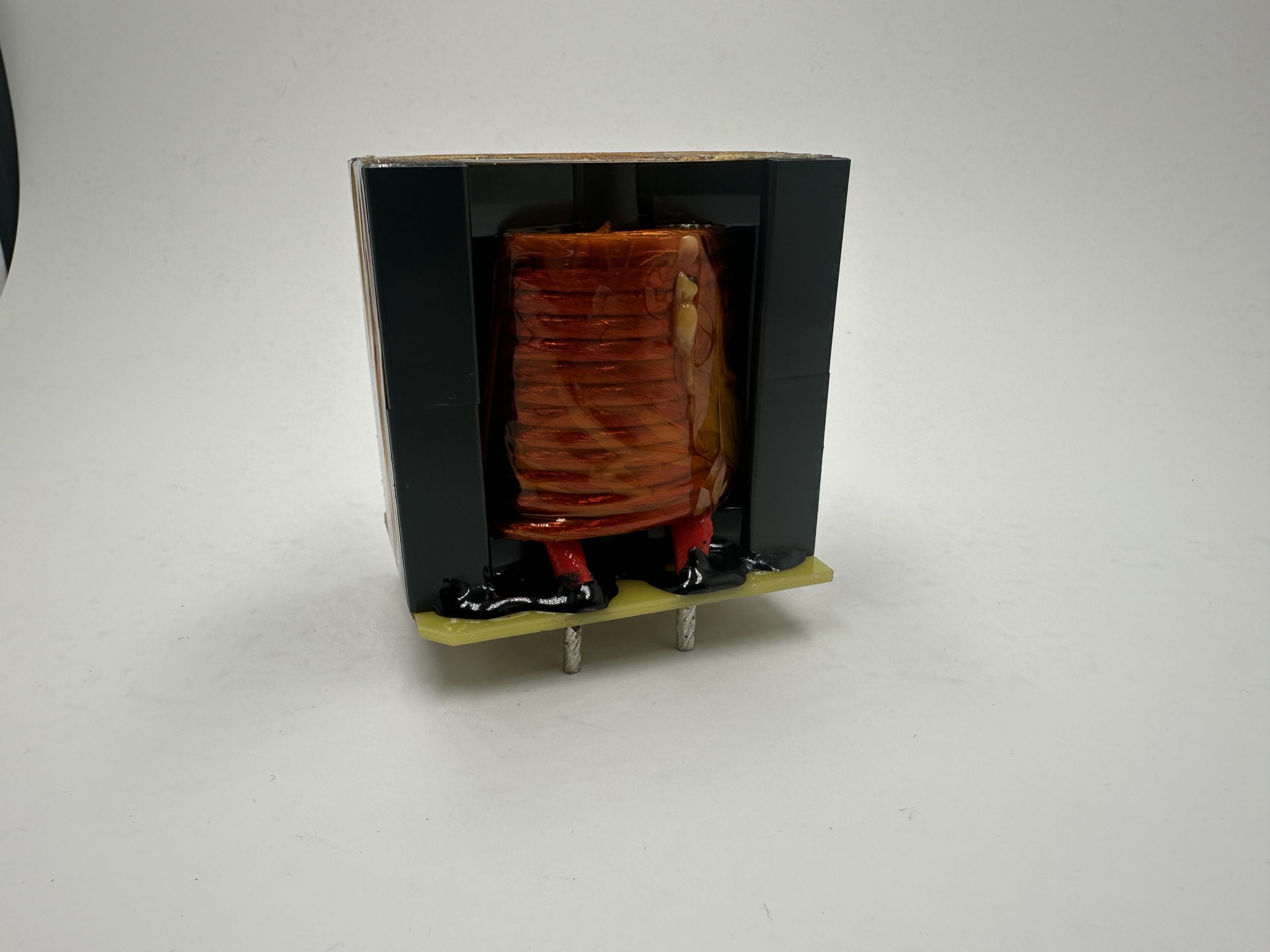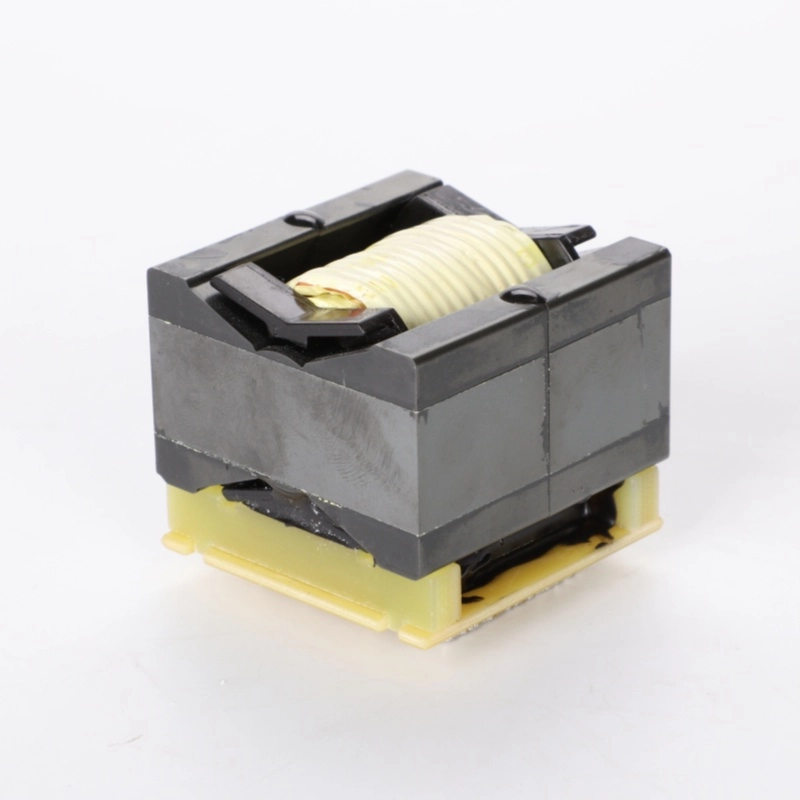
Many engineers new to switched-mode power supply (SMPS) design are confused when they first meet the flyback transformer in a textbook.
The book says: “A flyback transformer must store energy, so it needs an air gap.” But an air gap is just a slice of air — its permeability is
far lower than ferrite, so it conducts magnetic flux worse. Why would you deliberately carve a gap of air into the core? And if the gap lowers
the inductance, doesn’t lower inductance mean less stored energy?
Those two questions point at the same core misunderstanding: a flyback transformer is not a transformer — it is a coupled inductor.
1. The Core Conclusion
- A flyback transformer is essentially a coupled inductor (store first, release later), not a “transformer” in the conventional sense.
- Energy-storage formula: E = ½·L·I². The gap lowers the inductance L, but raises the saturation current Isat dramatically; as long as I grows faster than L shrinks, the total
L·I²stored energy actually increases. - The gap is a trade-off: sacrifice permeability (lower inductance) to gain a much larger saturation current and a higher energy-storage ceiling.
- The fundamental difference between flyback and forward: one is a warehouse of energy (flyback); the other is a conveyor of energy (forward).
2. Forward vs. Flyback: The Essential Topological Difference
Forward Converter
- Primary and secondary conduct simultaneously; power transfers directly from primary to secondary.
- The core only transfers energy, it does not store it. The peak flux density Bmax is set by the volt-second product, independent of load current.
- A typical forward transformer normally needs no air gap — the gap only lowers permeability and brings no benefit. A small/process gap appears only under DC bias, incomplete reset, or special design needs (not standard practice).
Flyback Converter
- When the switch is ON: the primary winding stores energy like an inductor; the secondary rectifier is OFF.
- When the switch is OFF: the energy stored in the core is released to the load through the secondary winding.
- Primary and secondary do not conduct at the same time — this is the essential difference between flyback and forward.
- The work cycle is store → release, which is why it should be called a coupled inductor.
3. What the Air Gap Really Does: Let the Energy “Get In”
- Without a gap, the B–H curve is very steep: ferrite permeability μ is typically 2000–3000, so a tiny current drives B straight to saturation. Once saturated, L collapses, current runs away, and energy simply cannot be held.
- With a gap, the effective magnetic path lengthens and the B–H curve flattens (effective μ drops to 1/5 ~ 1/10 of the original): at the same current, B is lower and farther from saturation, so the allowable maximum current rises sharply.
| Parameter | No gap | With gap (reasonable) |
|---|---|---|
| Permeability μ | 2000–3000 | 200–500 |
| Inductance L | High | Medium |
| Saturation current Isat | Low (~1 A) | High (~5 A) |
L·Isat² stored energy |
Small | 2–5× larger |
4. The Energy Is Actually Stored Mainly in the Gap’s Field
- From a field perspective, the energy density is w = ½·B·H.
- The gap’s permeability μ is far below ferrite, so at the same B the gap’s H is much larger — meaning its energy density is far higher than the core material’s.
- The gap volume is small, but per unit volume it stores far more energy than the core — that is exactly why opening a gap makes the total stored energy larger. (It is not “the air storing energy”; the gap simply lets the core tolerate a larger current and therefore store more.)
5. A Worked Example (EE16 Core)
- No gap: L = 1 mH, Isat ≈ 1 A → Emax = ½ × 1 mH × 1² = 0.5 mJ
- 0.3 mm gap: L = 200 µH, Isat ≈ 5 A → Emax = ½ × 200 µH × 5² = 2.5 mJ
- Conclusion: stored energy rises ~5× — sacrifice inductance to gain a larger saturation current and a higher storage ceiling.
6. The Reservoir Analogy (memory aid)
- No gap: the reservoir is shallow (high μ); a little water and it overflows (saturates).
- With gap: the reservoir is dug deeper (lower effective μ); it holds far more water (larger current, more energy) before overflowing.
- The energy is of course held in the reservoir, but without that deeper basin it could never hold this much water.
7. The Cost of the Air Gap
| Cost | Effect | Mitigation |
|---|---|---|
| Increased leakage inductance | Voltage spike on the switch; needs RCD snubber | Optimize winding layout (sandwich primary around secondary) |
| EMI | Conducted/radiated noise rises (fringing field couples to windings & PCB) | Shield winding, Y-capacitor |
| Higher copper loss | More turns needed for the same L | Use higher-Bsat core material; distributed gap (powder core) relieves fringing but costs more |
8. Air-Gap Requirements Across Magnetic Components
| Komponente | Gap needed? | Reason |
|---|---|---|
| Forward transformer | ❌ Normally no | Stores no energy ideally; Bmax set by volt-second; process gap only under bias/reset issues |
| Flyback transformer | ✅ Must | Stores energy; must avoid saturation |
| PFC boost inductor | ✅ Yes | Large DC bias; needs saturation resistance |
| Buck output inductor | ⚠️ Depends | Small-power ferrite needs a gap; large-power powder core has built-in distributed gap |
| LLC-Transformator | ❌ No | Mostly transfers energy; leakage/magnetizing inductance join the resonance |
| LLC external resonant inductor | ⚠️ By design | Large AC current; judge by core and current margin |
| Common-mode choke | ❌ Usually no | Differential fluxes cancel; suppresses common-mode; real leakage exists, evaluate if diff-mode bias is large |
9. FAQ
Why does a flyback transformer need an air gap?
Because a flyback transformer is really a coupled inductor that must store energy in the core. Without a gap the ferrite B–H curve is very steep, so a small current drives the flux to saturation; once saturated the inductance collapses and energy cannot be held. The gap lowers effective permeability, flattens the B–H curve, and lets the winding carry a much larger peak current before saturating.
What is the difference between a flyback and a forward converter?
In a forward converter the primary and secondary conduct at the same time and power transfers directly; the core only transfers energy and normally needs no air gap. In a flyback converter the primary stores energy while the switch is on and the secondary releases it while the switch is off; primary and secondary never conduct together, so the transformer acts as a coupled inductor and must store energy, which is why it needs an air gap.
Where is the energy actually stored in a gapped flyback transformer?
Mostly in the magnetic field of the gap. Energy density is w = ½ B H. The gap has far lower permeability than ferrite, so at the same flux density B the field strength H in the gap is much larger, giving a much higher energy density than the core material. The gap does not “store energy by itself” — it lets the core tolerate a larger current, so the total stored energy rises.
Does the air gap reduce the inductance?
Yes. The gap lowers the inductance L. But it raises the saturation current Isat far more. Stored energy is E = ½ L I², so as long as Isat grows faster than L shrinks, the total L·Isat² stored energy increases. Example: an EE16 core with no gap gives about 0.5 mJ, while a 0.3 mm gap drops L to 200 µH but raises Isat above 5 A, lifting stored energy to about 2.5 mJ, roughly 5× more.
Can you avoid the mechanical air gap?
Yes, by using a low-permeability toroid or a powder core (alloy powder core such as Sendust, High-Flux, MPP, or iron powder). These materials have a built-in distributed air gap and strong saturation resistance, so no separate machined gap is needed. A gapped ferrite is still the common choice for many flyback designs because of cost and loss trade-offs.
Is leakage flux the same as leakage inductance?
No. The escaping field at the gap is called leakage flux. Leakage inductance is produced by the spacing between the primary and secondary windings and exists even without grinding a core gap; it is measurable. They sound alike but are different concepts. The fringing flux at a gap does increase leakage and EMI, which is why flyback EMC is harder to tame than forward.
10. Explore Our Magnetic Components
TrafoPSU designs and manufactures custom magnetic components for SMPS, automotive, industrial, and medical applications.