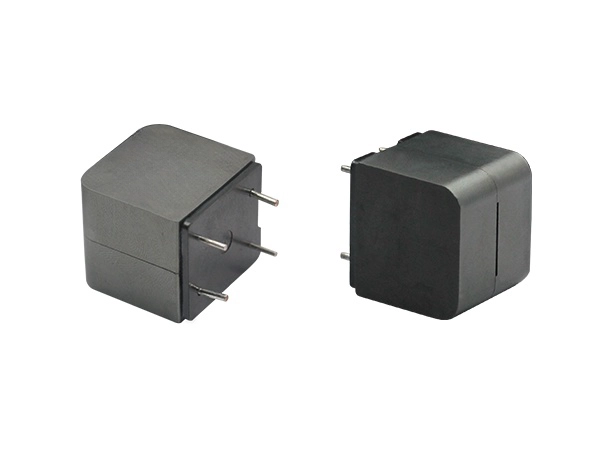
The schematic was clean. The simulation looked fine. On the bench, the LLC converter runs hot, the resonant frequency is off, and the efficiency sits several points below the target. Experienced power designers know this story, and the cause is frequently the magnetics. A custom transformer manufacturer in China can build the part you drew, but if the drawing missed one detail, the part will not do what the simulation promised.
Leakage inductance is part of the circuit
In an LLC converter, the resonant inductance can be provided by the transformer’s own leakage inductance, which is what an integrated LLC resonant transformer does. That saves a separate inductor. But leakage is determined by the winding structure, the bobbin, the gap and even how tightly the windings are wound, so it varies from one unit to the next. If the tolerance is too wide, the resonant frequency moves, and with it the gain curve and the operating point. Specify the leakage and magnetizing inductance with a sensible tolerance, and agree how and at what frequency it is measured.
Winding loss and litz wire
At high frequency, current crowds toward the surface of a conductor and neighbouring windings interact. The loss caused by this can be much greater than the DC resistance suggests. Litz wire, where many thin insulated strands are twisted together, reduces it, but it takes more winding space and costs more. A custom magnetic components manufacturer should be able to talk about strand size and how they handle the interleaving of windings, not only the wire gauge.
Core, temperature and saturation
Ferrite is the usual core material for transformers at these frequencies, with different grades optimized for different frequency and temperature ranges. Watch the temperature rise at full load, since core loss and copper loss both heat the part, and ferrite saturation flux density falls as the temperature climbs. A design that has comfortable margin at 25 degrees may not have it at 100.
Safety and insulation
If the transformer sits between the mains and the output, the insulation system must satisfy the safety standard for your product. That affects creepage and clearance distances, the margin tape on the bobbin, and the use of triple-insulated wire. Decide early, because the space this takes affects how many turns fit and how big the part becomes.
The other magnetics
The input filter matters as well. A nanocrystalline common mode choke offers high permeability, so it can give strong suppression at low frequencies where ferrite chokes need many turns. It is a popular choice for compact EMI filters and for noisy, high-power designs. It does cost more than ferrite, and it is sensitive to mechanical stress, so handling and potting methods matter.
For custom high current inductors, the key questions are saturation current and temperature rise. Powder cores saturate softly, which is forgiving, while ferrite gapped cores saturate abruptly, which is not. Flat or thick wire reduces resistance but changes the winding shape. Ask whether the stated current rating is for inductance drop, for temperature rise, or both.
Do not skip the sample stage. Wind a few units, measure leakage and magnetizing inductance on each, and run the converter at full load in a warm box for an hour or two. Compare the units against each other as well as against the design target. If two samples from the same batch differ a lot, the problem is in the winding process, and it is better to learn that now than in production. A transformer maker that is happy to share measurement data from each unit is a good sign.
Magnetics rarely get the attention they deserve at the schematic stage, and they punish that on the bench. Treat leakage, winding structure and insulation as design variables from day one, and the converter usually behaves. A transformer and inductor manufacturer that sees the whole converter can catch problems in design review instead of in your lab.
Custom transformers, inductors and common mode chokes are on the TrafoPSU website:https://www.trafopsu.com